
The Supreme Court has upheld the deletion of the 'waqf by user' provision in the amended waqf law, stating it is not arbitrary and addresses potential misuse.

The situation in Muslim-dominated Murshidabad district of West Bengal, which was marred by incidents of violence following protests over the Waqf (Amendment) Act, was calm and peaceful on Wednesday with no reports of any untoward incident. Prohibitory orders were clamped in and around Raghunathganj and Suti police station areas and large police force deployed in all sensitive areas of the district, especially in and around Jangipur town, where a large number of people had assembled on Tuesday afternoon, demanding the withdrawal of the legislation. Internet connectivity remained suspended within the areas under the Jangipur sub-division to prevent the spread of any disinformation. Protestors, who had gathered in large numbers on the NH-12 in the Jangipur area to protest against the Waqf Bill, hurled stones at the police who were deployed in the area, on Tuesday afternoon. A couple of vehicles belonging to the police were allegedly torched during the protest and police had to resort to lathi-charge and use tear gas shells to bring the situation under control. A few policemen were injured in the stone pelting. Police have also detained a few people in connection with the incident. West Bengal Governor C V Ananda Bose condemned the incident and said attempts to disturb the law and order situation in the state "should be put down with an iron hand". The opposition BJP alleged that the law and order situation in the state was "crumbling" under Chief Minister Mamata Banerjee, who was busy with "minority appeasement". The Waqf (Amendment) Bill was passed by the Lok Sabha on Thursday, and by the Rajya Sabha in the early hours of Friday after marathon debates in both Houses of Parliament. The Act aims to streamline the management of Waqf properties (assets permanently donated by Muslims for religious or charitable purposes) with provisions to safeguard heritage sites and promote social welfare. It also seeks to improve governance by enhancing transparency in property management, streamlining coordination between Waqf boards and local authorities and protecting stakeholders' rights.
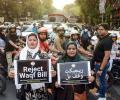
The Congress party announced its intention to challenge the constitutionality of the recently passed Wakf (Amendment) Bill, 2024 in the Supreme Court. AICC general secretary Jairam Ramesh stated that the party will "very soon" file a petition, citing concerns about the bill's impact on constitutional principles. Ramesh highlighted the Congress's ongoing legal challenges against other legislation, including the Citizenship Amendment Act (CAA), amendments to the Right to Information (RTI) Act, and changes to the Conduct of Election Rules. He emphasized the party's commitment to defending the Constitution's principles, provisions, and practices.
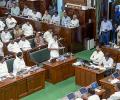
The Tamil Nadu Assembly passed a resolution on Thursday condemning the Centre's proposed Waqf Amendment Bill 2024, calling for its recall. Chief Minister M K Stalin argued that the amendment interferes with religious affairs and would negatively impact the Muslim minority. The resolution was unanimously passed by the Assembly, with support from all parties, including the opposition AIADMK and PMK. The BJP, however, walked out in protest, accusing the ruling DMK of engaging in divisive politics. The bill aims to streamline the Waqf Board's work and ensure efficient management of Waqf properties but has been criticized for potentially encroaching on religious freedom and autonomy. The Tamil Nadu government claims that the amendment would lead to government control over the Waqf Board and its properties, impacting its autonomy and potentially allowing for government acquisition of Muslim-owned lands.

Over one lakh Muslims gathered in Karnataka to protest the Waqf Amendment Act, 2025, which they say erodes the autonomy of Waqf institutions and threatens their rights. The protest, organized by the Karnataka State Ulema Coordination Committee, saw strong opposition to provisions in the amended law that they argue allow for coercive acquisition of Waqf properties. Leaders alleged that the amendment is part of a broader political agenda and urged the community to uphold their legal and constitutional rights.

It provides for a broad-based composition of the Central Waqf Council and the State Waqf Boards and ensures the representation of Muslim women and non-Muslims in such bodies.

The Supreme Court expressed its disapproval of an analogy used by the Centre in support of the inclusion of non-Muslims in Waqf boards, stating that such logic would disqualify a bench of Hindu judges from hearing matters related to Waqf. The CJI questioned the Centre's stance on the provisions of the Waqf (Amendment) Act, 2025, which allows non-Muslim members in the Central Waqf Council and state waqf boards. The Solicitor General defended the provisions, emphasizing that the non-Muslim inclusion is limited and does not impact the Muslim composition of these bodies. However, the CJI asserted that judges shed their religious affiliations while serving on the bench and maintained their secularity in their judicial capacity.
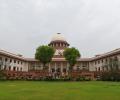
The Indian government has defended the Waqf (Amendment) Act, 2025 in the Supreme Court, arguing that there cannot be a blanket stay on the law as there is a presumption of its constitutionality. The Centre countered the pleas challenging the law's validity, asserting that the amendments were undertaken after a comprehensive study by a parliamentary panel. The government also highlighted the "reported misuse" of earlier provisions and the increase in waqf land, claiming that over 20 lakh hectares were added after 2013.

Two brothers have been arrested in connection with the brutal murder of a father-son duo during communal violence in Murshidabad district, West Bengal. The arrests bring the total number of people apprehended in connection with the recent violence in the district to 221. The violence erupted during protests against the Waqf (Amendment) Act.

Protests against the Waqf Act turned violent in parts of West Bengal on Friday, with demonstrators setting ablaze vehicles, disrupting traffic and rail movement, and injuring several policemen. The unrest erupted in Suti, Murshidabad district, where protesters defied prohibitory orders, hurled stones at security personnel, and torched police vans and public buses during processions. Police responded with lathi charges and tear gas, while some officers were forced to seek refuge in a nearby mosque. Similar protests were held in Malda and Kolkata, prompting Governor C V Ananda Bose to direct the state government to take swift action against those responsible. The governor also contacted Union Home Minister Amit Shah and held discussions with Chief Minister Mamata Banerjee. The Waqf (Amendment) Bill, which was recently passed by both houses of Parliament, aims to improve the management of Waqf properties, safeguarding heritage sites and promoting social welfare.

Uttar Pradesh Chief Minister Yogi Adityanath on Sunday condemned the violence in West Bengal's Murshidabad district following the passage of the Waqf (Amendment) Bill, accusing the opposition of instigating the violence. He also criticized the opposition for their alleged silence over the persecution of Hindus in Bangladesh and emphasized the BJP's commitment to protecting Hindus.

Opposition MPs, some of whom have given their dissent, slammed the exercise as undemocratic, claiming that they were given little time to study the final report and frame their dissent notes.

The Supreme Court of India has stayed several key provisions of the Waqf (Amendment) Act, 2025, citing potential violations of the Constitution. The court emphasized that laws should only be stayed in rare cases where provisions are manifestly unconstitutional or violate fundamental rights.

Underscoring the 'presumption of constitutionality in favour of law', the Supreme Court on Tuesday said petitioners challenging the waqf law needed a 'strong and glaring' case for interim relief.

The Archaeological Survey of India informed the JPC that 280 protected monuments have been listed as Waqf properties.
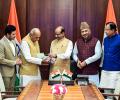
'When voting clause by clause on Waqf came up in the JPC, the TDP and JD-U supported the BJP on each and every clause.'

The opposition Peoples' Democratic Party and Peoples' Conference targeted the ruling National Conference over the meeting, and accused it of surrendering to the Bharatiya Janata Party without even a pretence over the passage of the Waqf act.
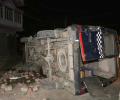
Supporters of the Indian Secular Front (ISF) clashed with police in West Bengal on Monday during protests against the Waqf (Amendment) Act, leading to several injuries and the torching of multiple police vehicles. The clash occurred after police stopped ISF supporters from attending an anti-Waqf Act rally in Kolkata. The protests escalated when the crowd attempted to break through police barricades. The situation was brought under control after a large police force was deployed. ISF leader Naushad Siddique condemned the Waqf Act and accused the BJP of trying to incite communal tension. Meanwhile, the ruling Trinamool Congress dismissed the ISF as a "party of no consequence." Communal violence related to the Waqf Act has also occurred in other parts of West Bengal.

India has rejected remarks by Bangladeshi officials on violence in West Bengal, asking Dhaka to focus on protecting the rights of its minorities instead of indulging in "virtue signaling." The statement comes in response to comments made by Bangladeshi officials regarding the developments in West Bengal. India's spokesperson pointed out that Bangladesh has failed to contain attacks on minorities, especially Hindus, in the country and urged Bangladesh to focus on protecting the rights of its own minorities.

The parliamentary panel's meetings have become a virtual battleground between the opposition and the ruling party members, who have been vociferously debating the changes to the Waqf Bill proposed by the government.
The Indian government defended the Waqf (Amendment) Act, 2025 in the Supreme Court, arguing that waqf, while an Islamic concept, is not an essential part of Islam. Solicitor General Tushar Mehta stated that waqf is essentially charity, which is recognized across religions, and cannot be considered a fundamental tenet of any faith. He also argued that the amended law addresses secular aspects of waqf and activities unrelated to Islam, and that "waqf by user" does not grant ownership of public land. Mehta highlighted the extensive consultations involved in the bill's creation, including feedback from various stakeholders. The hearing will continue on Thursday.

Congress Parliamentary Party chairperson Sonia Gandhi has criticized the Waqf (Amendment) Bill, calling it a 'brazen assault' on the Constitution and part of the BJP's strategy to keep society in a 'permanent state of polarization.' She also spoke out against the One Nation, One Election Bill, calling it a 'subversion of the Constitution.' Gandhi further accused the Modi government of ignoring the women's reservation bill and other demands for reservation, and of 'dragging the country into an abyss' where the Constitution will only exist on paper. She also criticized the government for limiting the speaking time of the Leader of the Opposition in Parliament and for not allowing discussions on important issues like the working of the defense and external affairs ministries and the challenges posed by China on the border.

Both factions of the Jamiat Ulema-e-Hind (Arshad Madani and Mahmood Madani) slammed the Bill and expressed grave concerns over the proposed legislation.

They stated that when a soldier fights for the nation, he does so not as a Hindu, Muslim, or any other religion, but as a patriot.

Ghanashyampur Primary School in Dhulian, Murshidabad district, West Bengal, reopened on Wednesday after a six-day closure due to violence in the area. The school had been shut since Friday noon after violence erupted on April 11 during a protest against the passage of the Waqf (Amendment) Act in Parliament. Several houses and properties were ransacked and set ablaze by a mob, leading to fear and disruption in the locality. While some guardians are still hesitant to send their children to school, teachers are optimistic that attendance will increase in the coming days.
It also cautioned that if the legislation is passed, the "two crutches" on which the Bharatiya Janata Party-led government is running at the Centre would not be able to escape responsibility.

In the aftermath of the violence, the police had arrested over 300 suspected miscreants in connection with over 60 FIRs which were lodged at various police stations in Murshidabad.

Introducing the bill, Rijiju said the consultation process of the Joint Parliamentary Committee (JPC) was the largest ever exercise carried out by a parliamentary panel in India's democratic history.

All opposition members of the parliamentary panel on the Waqf Amendment Bill were suspended for a day on Friday amid continuous protests and accusations against Chairman Jagdambika Pal of steam-rolling through the proceedings.

The parliamentary committee scrutinising the Waqf bill is set to propose that existing 'Waqf by user' properties will remain so if not in dispute or are government facilities but they must be registered before the new law takes effect, providing little relief to Waqf bodies in their unverified title claims.

Speaking to ANI on Wednesday, Razvi Bareilvi criticised Vijay for allegedly portraying Muslims negatively in his movies and for inviting individuals involved in gambling and liquor consumption to his iftar party.

A meeting of the joint committee of Parliament on the Waqf (Amendment) Bill on Friday witnessed fireworks with members vociferously opposing certain provisions of the draft legislation, leading to a brief walkout by opposition members.

Opposition MPs in the parliamentary committee scrutinising the Waqf (Amendment) Bill are scheduled to meet Lok Sabha Speaker Om Birla on Tuesday to protest its chairperson Jagdambika Pal's alleged 'unilateral' decisions and attempts to 'bulldoze' proceedings, indicating that they may disassociate themselves from the panel.

A chance meeting between Jammu and Kashmir Chief Minister Omar Abdullah and Union minister Kiren Rijiju at the Tulip Garden in Srinagar has sparked a political storm, with opposition parties accusing the National Conference of laying out a red carpet for the BJP leader in the aftermath of the Waqf Amendment Act. While NC sources termed the interaction as a purely coincidental encounter, opposition parties like the PDP and Peoples' Conference condemned the meeting, accusing the NC of surrendering to the BJP. The Waqf (Amendment) Bill, passed by Parliament last week, aims to streamline the management of Waqf properties with provisions to safeguard heritage sites and promote social welfare.

The Supreme Court refused to stay a provision barring the declaration of tribal lands as waqf properties, upholding key provisions of the Amended Waqf Act.

A major controversy has erupted in West Bengal after a TMC MLA announced plans to lay the foundation stone of a mosque modeled on the Babri Masjid, leading to political backlash and concerns over communal polarization.

The bill to amend the law governing Waqf boards proposes far-reaching changes in the Wakf Act, 1995, including ensuring the representation of Muslim women and non-Muslims in such bodies.
Justice Gavai's comment came while the apex court bench, also comprising Justice Augustine George Masih, was considering a fresh plea seeking an inquiry into the recent violence in West Bengal during anti-Waqf law protests.

Fourth-term Bharatiya Janata Party MP Nishikant Dubey, one of the more vocal party members in the Lok Sabha, launched a broadside against the Supreme Court on Saturday, saying Parliament and state assemblies should be closed down if the apex court has to make the laws.

The first day of the Bengali New Year, Poila Baisakh, passed without any celebrations in Dhulian, West Bengal, for the first time in over 50 years. Fear gripped the area following violence over the Waqf (Amendment) Act, leading to canceled rituals, shop closures, and a sense of uncertainty. The violence, which started on April 8, left three people dead and several injured. Protesters blocked highways, torched vehicles, and disrupted train services. While the police deployed central forces and imposed restrictions, locals still fear for their safety and demand permanent security measures. The town and its surrounding areas remain tense, with many families displaced and facing significant losses.
